

Employment Resource Network
This page includes upcoming employment focused events; state career and vocational services; veterans employment and training services; community resources; employers and employee resource groups; information from past summits; and relevant veterans census data.
Massachusetts Career & Vocational Services
The Department of Career Services in the Massachusetts Executive Office of Labor & Workforce Development provides employment opportunities and training programs to veterans and spouses of veterans who died of service-connected disabilities, have a 100% VA rating, or are MIA/POWs, who all receive Priority of Service in workforce programs funded by the U.S. Department of Labor.
-
Dedicated MassHire Veteran Service Representatives are available throughout the MassHire Career Center system of employment, training, and placement services, funded by the U.S. Department of Labor’s Veterans Employment & Training Service (DOL VETS).
-
Disabled Veterans' Outreach Program (DVOP) specialists are located in MassHire Career Centers across the state. DVOPs develop job and training opportunities for veterans with service-connected disabilities to help them compete in the job market. They also serve as case managers for veterans receiving VA Veteran Readiness & Employment (VR&E) vocational rehabilitation benefits.
DVOPs are funded by the U.S. Department of Labor. They also play a key role in promoting community and employer support for job and training opportunities, including apprenticeships and on-the-job training, by working directly with the VA, DoD, employers, community-based organizations, and veterans' organizations.
-
The Veterans Workforce Investment Program (VWIP) grant, awarded to the Department of Workforce Development & Division of Career Services, provides funding for short-term training (less than 48 weeks) for eligible veterans, leading to meaningful employment.
Amounts vary based on eligibility for other funding sources, generally ranging from $1,200 to $5,000. Grants can be combined with other veteran financial benefits (GI Bill, Chapter 115, etc).
Contact your local MassHire Career Center’s Veterans Services Representative to apply.
-
MassAbility offers Career Services (formerly known as their Vocational Rehabilitation Program). Massachusetts veterans who are not eligible to receive vocational rehabilitation and employment services through the VA may be eligible for MassAbility programs available to all eligible residents with impairments presenting large barriers to employment.
MRC’s Vocational Rehabilitation Program helps job seekers with with physical, cognitive, intellectual or mental health conditions obtain and maintain a job and manage the workplace. To be eligible for VR, individuals must live in Massachusetts and be eligible to work in the US. You can apply for VR services online or contact the VR Office in your area.
Individuals must want to work and need VR services to train, find, or keep a job; unemployed or underemployed individuals may also benefit from VR services. Eligibility information is gathered through current schools, physicians, therapists, hospital and other medical records, self report, Social Security Administration, and psychological or neurological evaluation.
DOL Veterans Employment & Training Service
The US Department of Labor’s Veterans Employment & Training Service (DOL VETS) protects employment rights under Uniformed Services Employment & Reemployment Rights Act (USERRA), prepares veterans for meaningful careers, provides employment resources, and promotes employment opportunities to help service members, veterans, and military spouses find employment.
-
Transition Assistance Program (TAP) is a cooperative interagency effort among the DOL, and the DOD, DOE, DHS, and the VA, SBA, and OPM to support transitioning military.
-
Jobs for Veterans State Grants (JVSG) provides federal funding to state workforce agencies to hire dedicated staff to provide individualized career and training-related services to veterans and eligible persons with significant barriers to employment and to assist employers fill their workforce needs with job-seeking veterans.
-
Homeless Veterans’ Reintegration Program (HVRP) is a grant focused exclusively on competitive employment for homeless veterans. HVRP grant recipients place veterans experiencing or at risk of homelessness, homeless veterans with children, and justice-involved veterans into competitive employment at the local level.
-
National Veterans’ Training Institute (NVTI) provides specialized training and professional skills enhancement for state workforce agencies and service providers staff, focusing primarily on those who help veterans secure long-term employment to ensure those tasked with this critical responsibility have the knowledge and tools necessary to perform their jobs effectively.
-
HIRE Vets Medallion Program (HVMP) is an employment award that recognizes a company or organization’s commitment to veteran hiring, retention, and professional development.
Transition Employment Assistance for Military Spouses & Caregivers (TEAMS) is a series of workshops that extend the Transition Assistance Program to assist military spouses and caregivers as they plan and prepare for their job search. TEAMS workshops are instructor-led and like OBTT workshops, can be taken in any order online.
VBA Veteran Readiness & Employment Services
Veterans may receive Veteran Readiness and Employment (VR&E) services, formerly known as Vocational Rehabilitation and Employment, through the Veterans Benefits Administration (VBA) to help with job training, education, employment accommodations, resume development, and job seeking skills coaching. VR&E can also assist veterans and service members in starting their own businesses and provide independent living services for those who are severely disabled and unable to work in traditional employment. Click here learn more about eligibility and how to apply.
VHA Vocational Rehabilitation Services
The Veterans Health Administration (VHA) Vocational Rehabilitation Services provide therapy-first, clinical pathways inside VA medical centers designed to help veterans overcoming physical, mental health, or transitional challenges re-enter the workforce. Unlike standard job placement boards, these programs are integrated directly into veterans’ healthcare plans to support overall wellness, recovery, and long-term career stability.
-
The VHA Compensated Work Therapy Page matches veterans’ vocational goals with paid, therapeutic work experiences to build recent work history and stamina. Transitional Work (TW) is a time-limited, paid vocational rehabilitation program designed to help veterans transition back into competitive employment.
TW places veterans who face complex employment barriers into structured, therapeutic work assignments. Participants earn at least the federal or state minimum wage while rebuilding job-readiness skills, establishing routine stability, and engaging in regular, biweekly counseling with vocational specialists to manage structural barriers and transition into long-term careers.
The VA Boston Healthcare System offers standard CWT-TW assignments integrated with regional homeless veteran outreach teams, alongside a specialized Compensated Work Therapy-Transitional Residence (CWT-TR) program at the Jamaica Plain campus that couples employment coaching with supportive, transitional housing.
The VA Bedford Healthcare System offers a CWT Community Reintegration vocational track providing structured work placements, integrated psychosocial rehabilitation (including Cognitive Behavioral Therapy and Motivational Interviewing), and an integrated CWT Transitional Residence program.
The VA Central Western Massachusetts Healthcare System provides customized CWT Transitional Work placements out of the Leeds/Northampton campus, including localized job-readiness rehabilitation and access to a dedicated 16-bed off-campus CWT Transitional Residence program focusing on independent living.
The VA Providence Healthcare System operates dedicated CWT vocational therapy tracks providing paid work placements, structured work-hardening routines, and targeted regional job placement networks via an on-site Employment Resource Center serving veterans throughout Rhode Island and southeastern Massachusetts.
-
The Supported Employment (SE) and Individual Placement and Support (IPS) programs are designed for veterans navigating severe barriers or serious mental illness (such as PTSD). Vocational specialists work with veterans one-on-one to rapidly identify competitive community jobs and provide ongoing, long-term coaching.
-
Community-Based Employment Services (CBES) are tailored for veterans ready to transition directly into competitive job markets who just need short-term, case-managed support with resume building, interview prep, and initial workplace adjustments.
-
Supported Education & Self-Employment offers dedicated counseling and guidance at select medical centers to help you navigate school admissions, utilize GI benefits effectively, or map out the initial stages of launching a small business.
Because these are clinical health programs, you can’t apply online. To enroll in the VHA’s Vocational Rehabilitation Services, veterans should request a CWT Clinical Consult from their VA primary care provider, social worker, or mental health coordinator.
Bob Woodruff Foundation Hiring Portal
The Bob Woodruff Foundation’s Hiring Portal is available to all VOWS corporate partners and veteran job seekers. If your organization is hiring and you’re targeting veterans, create and personalize your corporate profile, highlight your hiring needs, and promote any training opportunities and mentorship programs to gain access to a pool of veteran applicants. If you’re a job seeker who’s also a veteran, military spouse or military family members, you can search for roles, and access training, a resume builder, a military skills translator, and mentorship opportunities.

Candorful provides job interview preparation and practice for veterans, transitioning service members, and military spouses. All coaching sessions are provided live via video conferencing with volunteer interview coaches from a variety of industries.
Click here to schedule a 30-minute video meeting with a Candorful Coach to prepare for practice interviews. After the initial intro session, candidates can choose from over 130 interview coaches to complete interview practice sessions.
If you have strong experience conducting interviews and are interested in becoming a Candorful Coach, click here to join an upcoming information session.
Employment Resource Network
The Veterans Collaborative Network Directory is a shared resource that includes the various organizations and programs participants are affiliated with, as long as they’ve signed in or otherwise participated in our summits to help us map the landscape. This is not an exhaustive list, but you’ll find many organizations offering employment services and mentoring, as well as employers and employee resource groups (ERGs).
Employment Support
Employers & Employee groups
Developed by Swords to Plowshares, TOOLBOX.vet is an online library. What You Should Know About Veteran Employment Services helps advocates/providers understand how military training/skills fit into a civilian workplace, how to help veterans frame their skills, and how to apply a culturally-informed approach to hiring and supporting veterans in the workplace.
PsychArmor offers CE Credits for HR Personnel, along with on demand classes, including The Job Search for Military Spouses, Remote Work for Veterans & Caregivers, and Veteran 201: Profession vs. Occupation.
Past Employment Summits
-
On October 28, 2020, the Veterans Collaborative hosted a virtual community summit titled The Elements of a Successful Veteran Employee Resource Group, organized by Mike Dunford with the Employment Resource Network. We heard from a panel of representatives from several successful corporate ERG programs that have added value to organizations while assisting them to employ, understand and empower veterans in the defense contracting, pharmaceutical, technology, health, and banking industries.
-
On April 3, 2019, the Greater Boston Veterans Collaborative convened a community summit focused on Programs to Assist Veterans with Employment, which was hosted by Brighton Marine.
In addition to hearing from veterans who have successfully transitioned to learn about the programs and resources they used that had an impact and made a difference, we also heard about some of the programs veterans are working for supporting their fellow veterans in their careers:
Jayson Gilberti, CEO, MVPVets
Andy McCarty, Director, Northeastern University Center for the Advancement of Veterans & Servicemembers
Charlie DuQuette, Outreach Specialist, Veterans Inc
Christopher Feugill, Veterans Employment Counselor, MassHire
-
On April 4, 2018, GBVC convened a Military & Veteran Employment Summit, hosted by Brighton Marine. Facilitated by Mike Dunford, panelists and participants discussed how companies attract, recruit, and most importantly, retain military veteran talent, providing insights into the employer's side of recruiting and addressing retention challenges, along with showcasing organizations that provide support for veterans with employment challenges.
-
On May 11, 2017, GBVC convened an Employment & Entrepreneurship Summit, which was hosted by Brighton Marine. This summit focused on programs supporting employment and entrepreneurship among veterans. We also reviewed RAND’s recent Assessment of Needs, Well-Being, & Available Resources for Veterans in Massachusetts. We heard from:
Barry Rosenbloom, TechSandBox VET Program (focused on military entrepreneurs in tech)
Chris Pratt, Veteran Entrepreneur Series (programming aimed at connecting, inspiring, and supporting military veterans in their efforts to start business and “take the leap” into entrepreneurship)
Christopher Feugill, MassHire, on state, local, federal, and non-profit employment resources available for veterans.
GBVC also reviewed RAND’s pertinent findings from RAND’s recent Assessment of Needs, Well-Being, & Available Resources for Veterans in Massachusetts. After the speaking program, we had deep dive discussions in breakout groups on veteran entrepreneurship and employment, including discussion of the findings from the RAND report.
Key Topics
Outreach and opportunities to find and engage veterans to bring awareness of professional development, internship, and fellowship programs that are available for career growth
Diversity, equity, and inclusion efforts
Educating employers on veteran hiring and maintaining quality control of programs and resource groups that support employees in the military and veteran community
Supporting awareness of employment representatives and others supporting personal, professional, and career initiatives of the range of pathways available and encouraging referrals
Submitting events to the shared calendar using the tag employment and other tags so they appear above and on relevant resource or regional pages (ie, fellowship, entrepreneurship, volunteering).
Creating space for organizations focused on employment tracks for veterans to connect with each other and strategize on ways to support unique or individualized paths and goals
Encouraging employment-focused organizations to also connect job seekers to entrepreneurship programs or training opportunities
Ensuring spouses and survivors are aware of military and veteran employment programs that also have programs for them
Forming affinity groups to organize and facilitate employment community summits on relevant topics and issues and to collect and share information and resources on this page.
Shared Resource Tracker
Massachusetts Veterans Census Data
Education, Employment & Median Annual Income
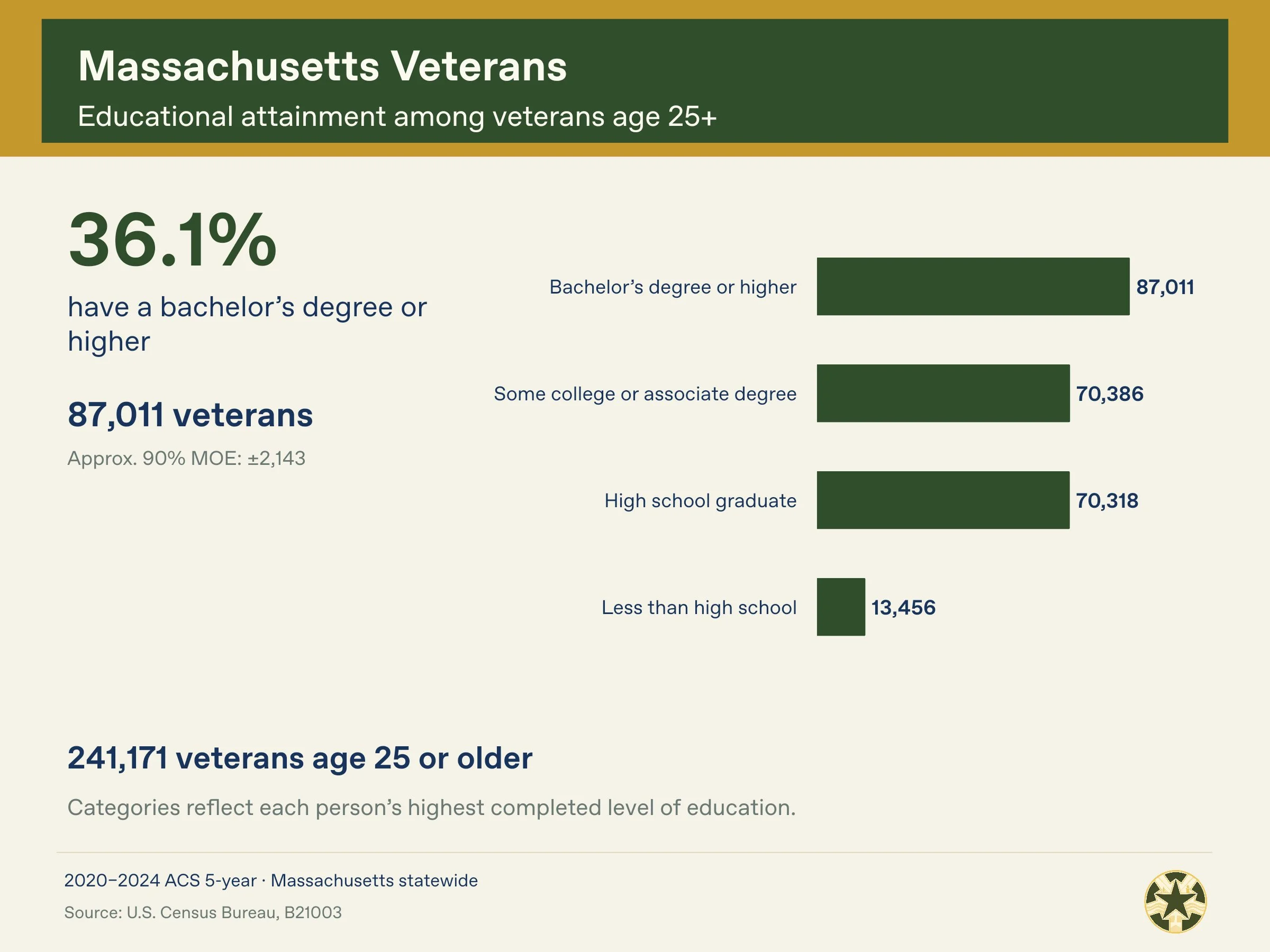
Based on the 2020–2024 ACS 5-year estimates, approximately 36.1 percent of Massachusetts veterans age 25 or older had a bachelor’s degree or higher, compared with 47.8 percent of nonveterans in the same age range. Another 29.2 percent of veterans had some college or an associate degree, 29.2 percent had a high school diploma or equivalent, and 5.6 percent had not completed high school.
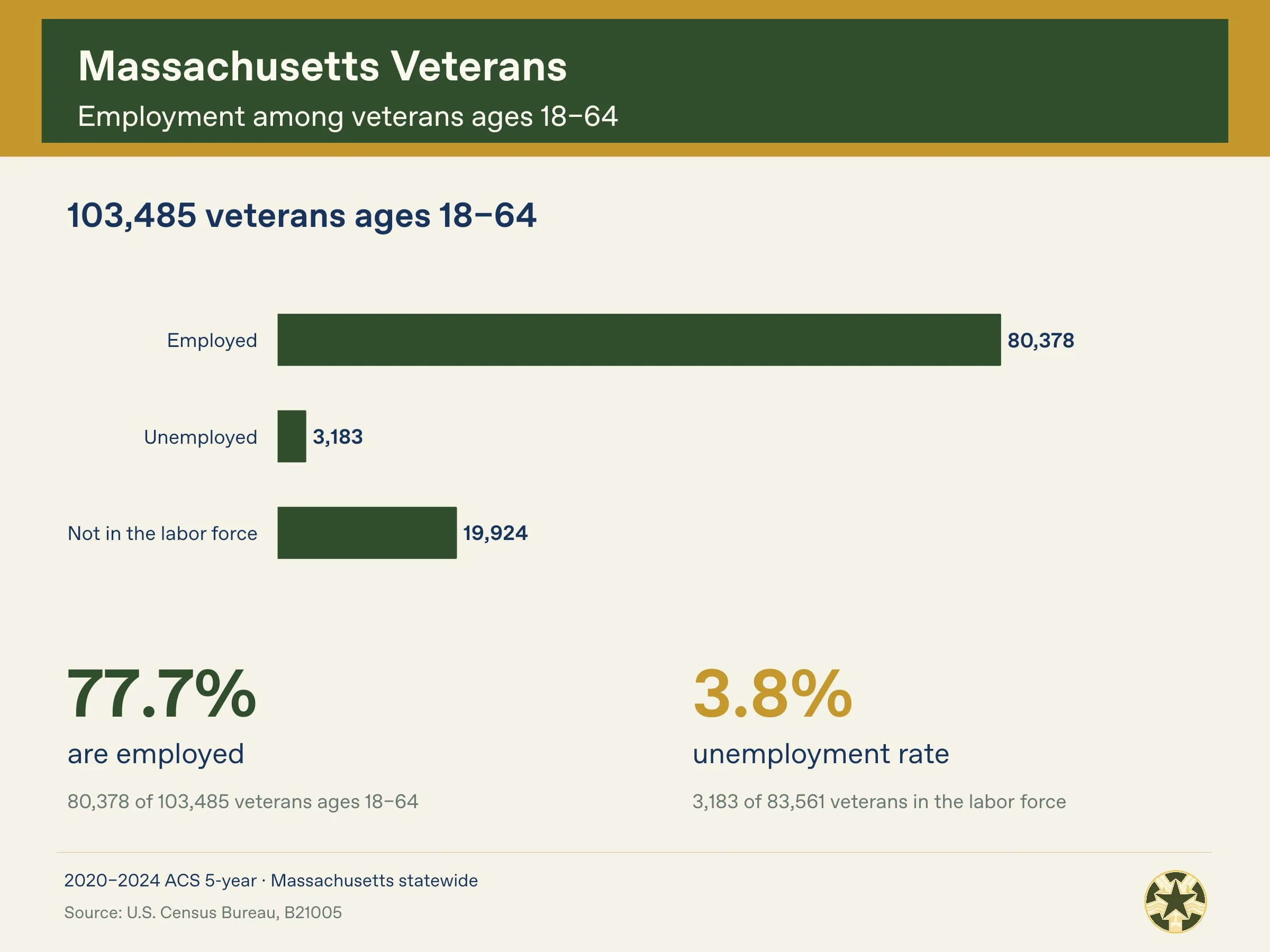
Among veterans ages 18–64, approximately 77.7 percent were employed and 19.3 percent were outside the labor force. The veteran unemployment rate was 3.8 percent, compared with 5.1 percent among nonveterans ages 18–64.
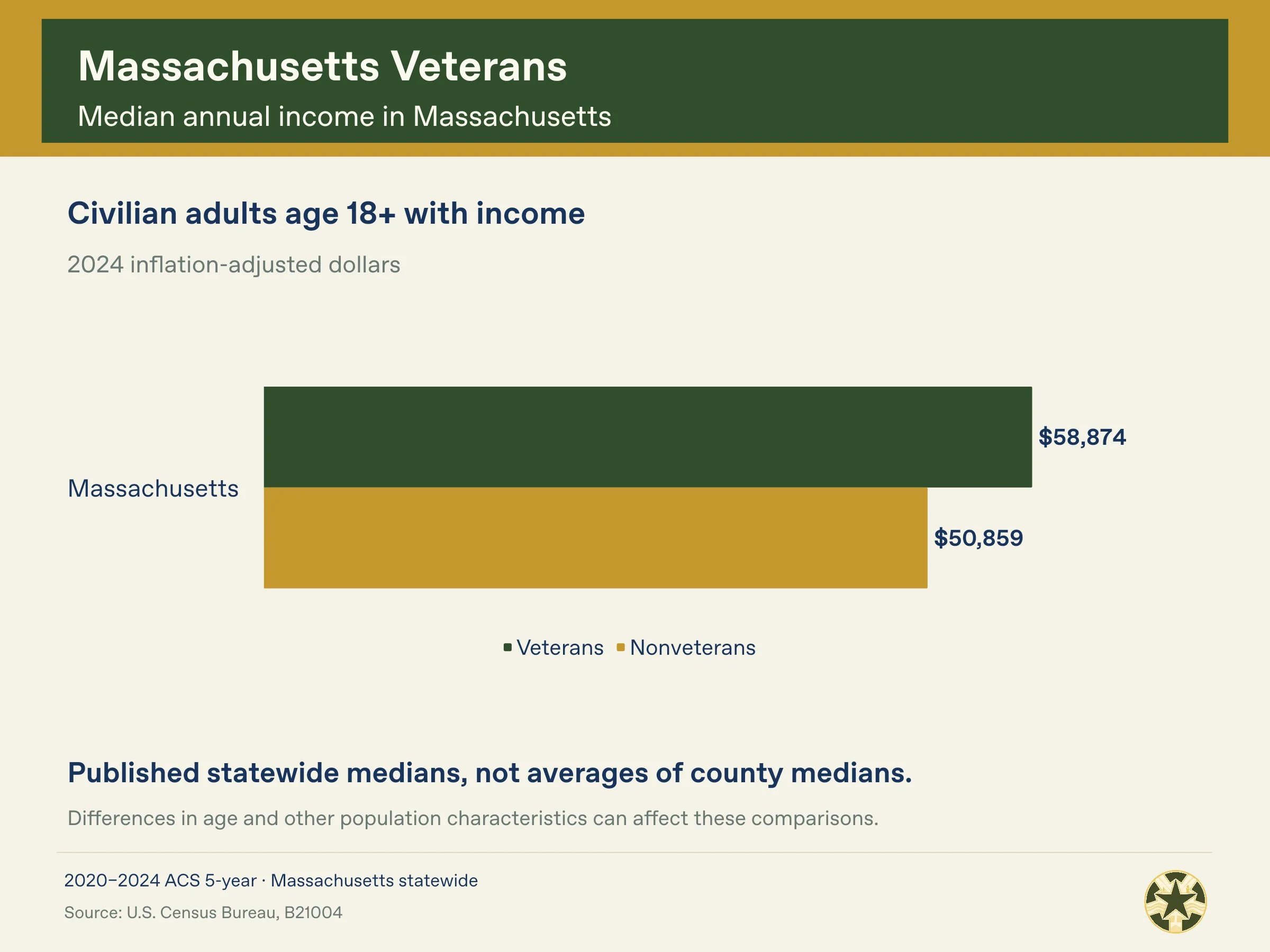
Median individual income for Massachusetts veterans was $58,874. Estimates varied considerably across the state, including $45,029 in Franklin County and $67,073 in Plymouth County.
Our analysis of the census data also found that the median annual household income was $107,415 for Massachusetts households with at least one veteran resident.
““Efforts and courage are not enough without purpose and direction.””